Manipur CM Reviews Fisheries Sector, Indigenous Fish Production Rises as Imports Drop
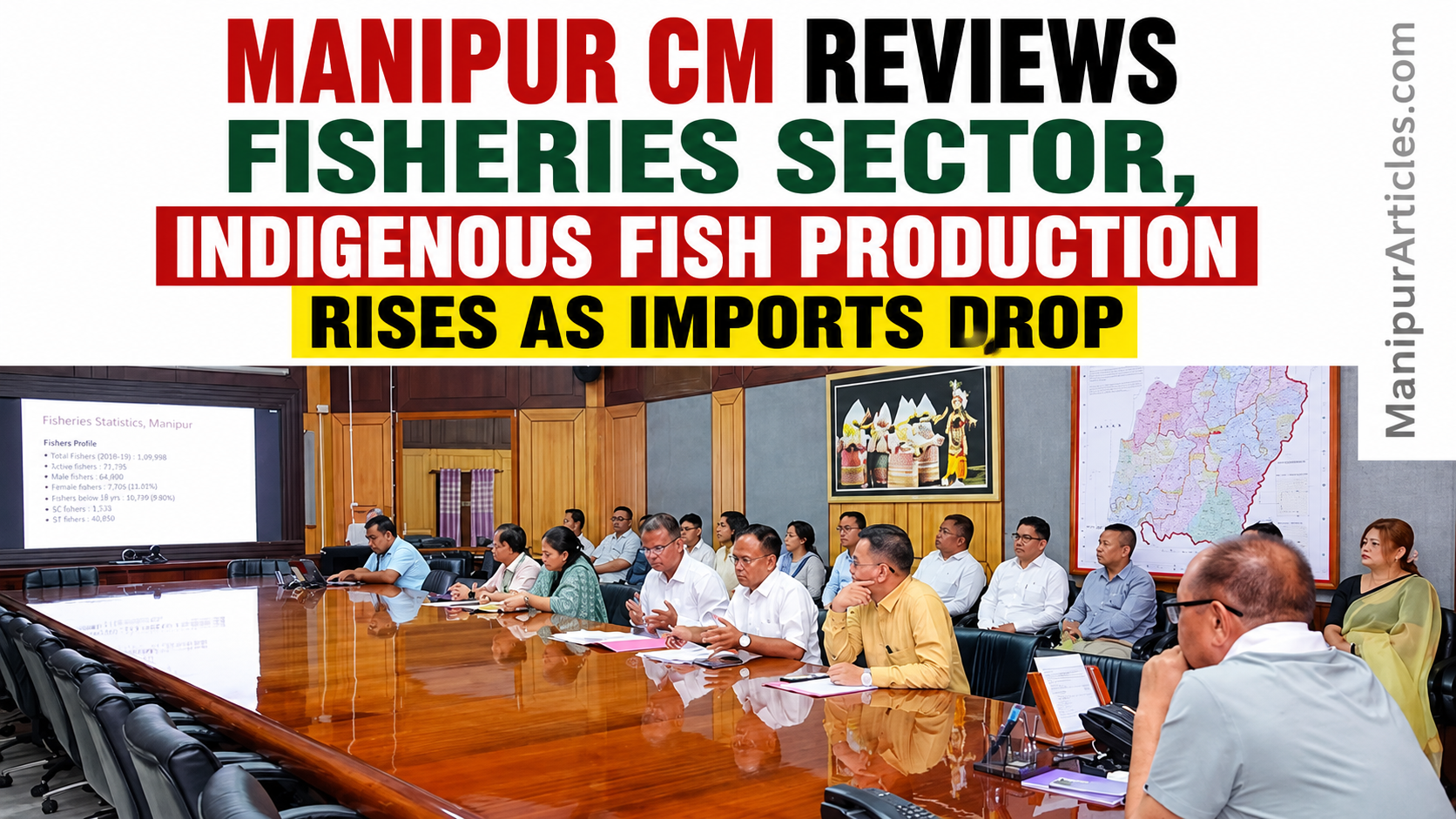
Imphal, July 14: Manipur Chief Minister Yumnam Khemchand Singh chaired a high-level review meeting with officials of the Fisheries Department on July 13 to assess the state’s progress in strengthening indigenous fish production and reducing dependence on imported fish.
The meeting focused on expanding sustainable aquaculture, improving fish production, and enhancing the livelihoods of fishing communities as part of the government’s long-term strategy to achieve self-sufficiency in the fisheries sector.
According to officials, Manipur has significantly reduced its expenditure on fish imports. The state now procures fish worth around ₹200 crore annually, compared to nearly ₹400 crore in previous years, reflecting a steady rise in local production.
At present, Manipur produces approximately 4.5 crore kilograms of fish each year, while the state’s annual demand is estimated at around 6.75 crore kilograms, leaving scope for further expansion in domestic production.
Sharing the government’s vision in a Facebook post, Chief Minister Yumnam Khemchand Singh stated, “The Government remains committed to strengthening the fisheries sector by promoting sustainable pisciculture and enhancing the livelihoods of our fishing communities.”
With one of the highest per capita fish consumption rates in the country, the state has intensified efforts to promote scientific aquaculture across natural lakes, wetlands, and private ponds. These initiatives have helped increase annual table fish production to around 37,125 metric tonnes.
To conserve indigenous fish species, the Directorate of Fisheries recently released nearly 10 lakh fingerlings into Loktak Lake at Moirang and launched an extensive river ranching programme across 12 major rivers, including the Imphal, Nambul, and Thoubal rivers.
The state has also partnered with ICAR-Central Inland Fisheries Research Institute (ICAR-CIFRI) to expand reservoir fisheries in the 1,100-hectare Mapithel Reservoir in Kamjong district. The initiative aims to create sustainable livelihood opportunities for tribal communities through scientific fisheries management.
In addition, the Loktak Livelihood Mission is promoting integrated aquaculture while encouraging the conversion of invasive phumdis (floating biomass) into organic fertiliser, supporting both environmental conservation and sustainable farming.
Under the National Welfare for Fishermen scheme, financial assistance is being provided to economically weaker fishers for constructing low-cost houses, community ponds, and tube wells to improve their living standards.
To encourage entrepreneurship in the fisheries sector, the government continues to promote initiatives such as the annual Emoniu Fish Festival and National Fish Farmers’ Day, providing local fish farmers with direct marketing opportunities. Regular training programmes on reservoir fisheries management and induced carp breeding are also being conducted to enhance technical skills among fishermen and women across the state.