Manipur Puts Boundary Reorganisation on Hold Until 2027 Amid Census Plans
The Manipur government has announced a freeze on administrative boundaries across the state from January 1, 2026, to March 31, 2027, as part of preparations for upcoming census operations. The decision applies to all districts, tehsils, villages and other administrative units in Manipur.
According to a Gazette notification issued on December 31, Governor of Manipur Ajay Kumar Bhalla stated that the move was made in exercise of powers conferred under Clause (iv) of Rule 8 of the Census Rules, 1990. The notification clarified that the freezing of boundaries is intended to facilitate smooth and systematic conduct of census-related activities during the specified period.
Manipur currently has 16 districts, comprising six valley districts and ten hill districts. The freezing of boundaries means that no changes such as creation of new districts, reorganisation of tehsils, or alteration of village limits will be permitted during the census preparation and enumeration phase.
However, the decision has sparked significant opposition from political parties and civil society organisations, who argue that the prevailing situation in the state is not conducive for conducting a census. The notification comes at a time when Manipur continues to grapple with the fallout of prolonged ethnic violence, large-scale displacement and persistent security concerns.
At a conclave held in Imphal on December 27, representatives of 12 political parties, including the BJP, Congress, NPP, JD(U), MPP, AAP, CPI, CPI(M), DMP and Shiv Sena, jointly opposed the proposed census exercise. The conclave was organised by the Campaign for Just and Fair Delimitation (JFD), which adopted a unanimous resolution urging the Central government to defer the 2027 Census in Manipur until peace and normalcy are fully restored.
Political leaders at the conclave expressed concern that conducting a census under the current circumstances could lead to inaccurate population data, particularly due to ongoing displacement and restricted movement in several hill areas. They warned that flawed census figures could have long-term implications for political representation, delimitation of constituencies and allocation of development resources.
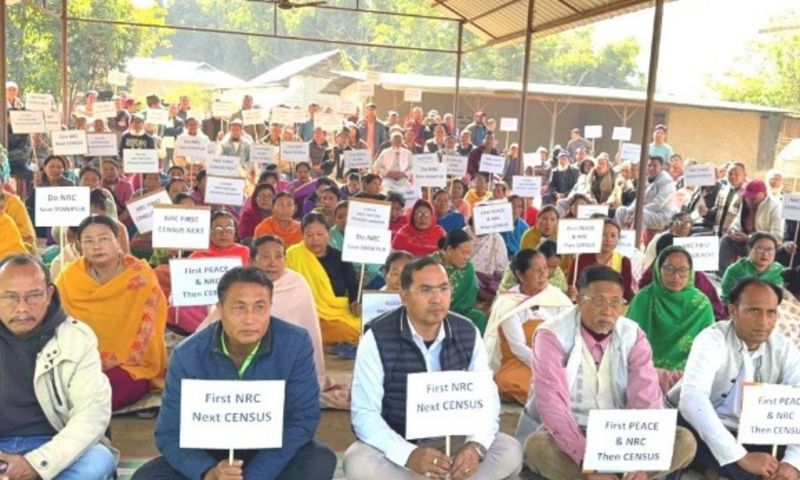
Public protests have also emerged against the census announcement. On December 29, 2025, a sit-in demonstration was organised at Wangoo Sabal in Bishnupur district, where protesters raised slogans such as “No NRC, No Census,” “NRC First, Census Next,” and “Peace and NRC First, Then Census.” The demonstrators demanded that the National Register of Citizens (NRC) be completed before any census exercise is undertaken in the state.
Social worker Sanjoy Ahanthem, speaking during the protest, said there is widespread fear and apprehension among the people regarding Census 2026. He stated that the ongoing ethnic conflict, displacement of tens of thousands of residents and alleged presence of illegal immigrants could distort population data. According to him, such inaccuracies may adversely affect indigenous communities by influencing future political and administrative decisions.
Several civil society groups have echoed these concerns, stressing that restoration of peace, rehabilitation of displaced persons and completion of NRC should be prioritised before conducting a census. They argue that only a stable and secure environment can ensure a fair, transparent and credible population count.
Despite the opposition, the state government maintains that freezing administrative boundaries is a routine and mandatory step under census rules. As debates continue, the issue has emerged as a sensitive political and social matter in Manipur, highlighting the deep link between census operations, demographic concerns and the broader quest for peace and stability in the state.