Manipur Delegation Visits Border Villages After Myanmar-Based Militant Attack, Demands Stronger Security
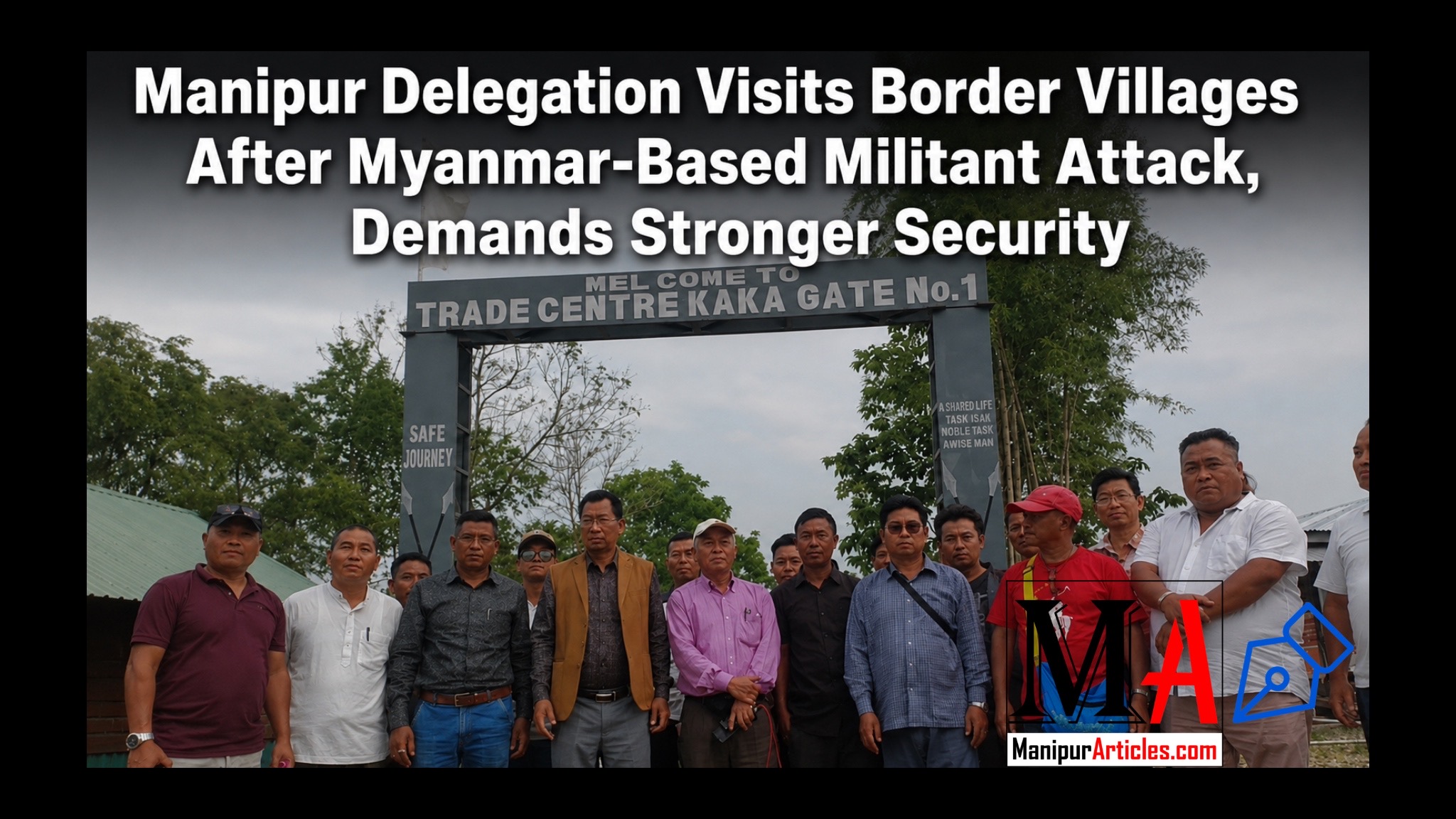
A joint delegation of civil society groups from Manipur on Monday visited several villages located along the India-Myanmar border following the deadly May 7 attacks allegedly carried out by Myanmar-based armed groups. The delegation inspected the ground situation in the affected Naga villages and condemned what it described as a serious act of cross-border aggression.
The team included representatives from the Indigenous People’s Forum Manipur (IPFM), All Manipur United Clubs’ Organisation (AMUCO), Manipur Naga Youth Organisation (MNYO), Tangkhul community elders, and several Meitei intellectuals. During the visit, the delegation toured the heavily affected villages of Namlee, Wanglee, and Choro to assess the extent of destruction caused by the violence.
Apart from conducting an on-ground inspection, the delegation also distributed relief materials to families impacted by the attacks. According to their preliminary inquiry report, several houses were burned down, vehicles were destroyed, and many belongings were allegedly looted during the assault.
Civil society leaders strongly criticized the incident, calling it a major security failure along the international border. AMUCO advisor Devan alleged that the attacks were carried out by the Kuki National Army-Burma (KNA-B). He also criticized recent comments made by the state Home Minister, who reportedly stated that no official confirmation of foreign aggression had been received. Devan termed the remarks “deeply unfortunate,” especially after rescue operations conducted by the Indian Army in the affected region.
IPFM chief advisor Ashang Kasar described the violence as a clear case of “external aggression” against Indian territory. Speaking during a solidarity gathering in Namlee village, he urged the authorities to establish a permanent security presence in the area through an Indian Reserve Battalion (IRB) or a Manipur Rifles outpost. He also demanded immediate reconstruction support for the damaged homes and infrastructure.
Meanwhile, MNYO president Daniel Lamkang asserted that Choro village lies well within Indian and Naga territory. He condemned both the KNA-B and the People’s Defence Force (PDF) for allegedly carrying out hostile activities across the border and described the attacks as foreign aggression against local communities.
Village leaders from Namlee and Choro also highlighted years of neglect in the remote border areas. They demanded urgent government action to improve essential services such as road connectivity, electricity supply, telecommunications, healthcare, and educational infrastructure. They also called for stronger deployment of security personnel to prevent future attacks.
Members of the delegation expressed dissatisfaction with the response of the state government, arguing that the attacks took place close to existing army installations. They warned that continued weaknesses in border security could create serious concerns over territorial vulnerability and national security in the sensitive border region.