Manipur: Kuki Chiefs Protest Indo-Myanmar Boundary Realignment, Say ‘Not an Inch of Our Land’
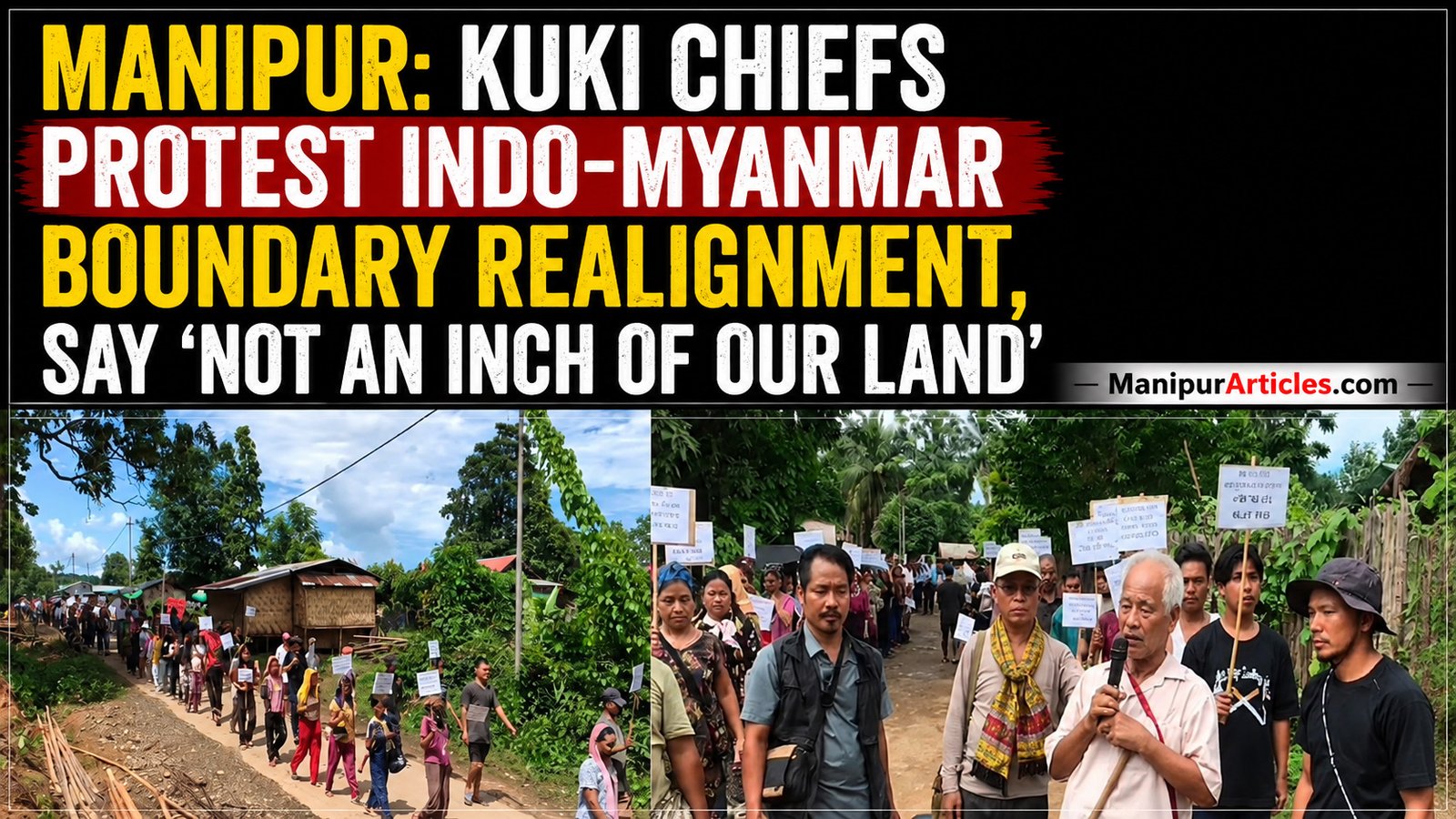
Chandel, Manipur: Thousands of people gathered in Manipur’s Chandel district on August 11 to protest against the proposed demarcation and realignment of the Indo-Myanmar international boundary in the Khengjoi sector.
The mobilisation was organised under the banner of affected border-area Kuki chiefs, who have demanded that the existing position of the boundary be maintained and opposed any proposed relocation of boundary pillars.
Protests Held in Khengjang and Molcham
Demonstrations were held at Khengjang and Molcham villages, where residents and affected Kuki chiefs raised objections to the proposed boundary exercise.
The protesters argued that shifting the existing boundary alignment could have a direct impact on ancestral settlements, agricultural fields, burial grounds and customary community land.
The chiefs maintained that the areas along the frontier are not simply unoccupied stretches of land but are connected to the history, livelihood and traditional practices of generations of local residents.
“This is not merely a question of boundary pillars. These are our ancestral homesteads, cultivation fields, burial grounds and customary commons,” the chiefs said.
Objection to Proposed Boundary Pillar Relocation
The proposed realignment reportedly involves Boundary Pillars 65 at Molcham, 66 at Jangngoulen, 67 at Khumkot and 68 at Joldam.
The affected Kuki chiefs claimed that the proposed alignment does not correspond with what they consider the existing position of the boundary on the ground.
According to the protesting communities, the present alignment has traditionally been recognised and occupied by local residents, and any alteration could affect established settlements and agricultural activities.
Communities Raise Concerns Over Demarcation Process
The mobilisation followed claims by affected communities that the Ministry of Home Affairs had directed the completion of the demarcation exercise within three months following a meeting chaired by Union Home Minister Amit Shah on May 11.
The Kuki chiefs alleged that the concerns of communities that could be directly affected by the proposed realignment had not been adequately addressed before the exercise was taken forward.
They argued that consultation with affected border villages should be an essential part of any decision concerning changes to the existing boundary alignment.
Chiefs Reject Any Unilateral Change
The affected Kuki chiefs strongly opposed what they described as an undemocratic move and said they would not accept the loss of land traditionally associated with their communities.
“We cannot accept this undemocratic move of the government. Not an inch of our land will be parted,” they said.
They urged both the Central government and the Manipur government to consider the concerns raised by border villages before proceeding with any proposed realignment.
The chiefs also demanded that the existing boundary position should not be altered without first addressing the claims and concerns of the communities directly affected by the exercise.
Land, Livelihood and Heritage at Centre of Dispute
According to the protesting communities, land along the Indo-Myanmar frontier plays an important role in local livelihoods and is closely linked with ancestral heritage.
They argued that an alteration of the boundary could potentially affect cultivation patterns, settlements, burial sites and access to customary community land.
The organisers described the gathering at Khengjang and Molcham as a collective expression of opposition to any boundary demarcation process that, in their view, does not adequately consider the existing ground position and the interests of communities living along the frontier.
Boundary Issue Adds to Manipur’s Political Sensitivities
The protest comes amid continuing political sensitivity over land, territorial boundaries, identity and the rights of indigenous communities in Manipur.
The proposed Indo-Myanmar boundary exercise has therefore emerged as another contentious issue in the state, particularly among communities living in border areas.
The affected Kuki chiefs have maintained that the government should engage directly with the communities before taking any decision that could alter the existing boundary alignment.
Further developments are expected as authorities consider the objections raised by the affected border communities.
Disclaimer: The statements regarding the proposed boundary realignment, existing ground position and government directions are based on claims and statements attributed to the protesting communities and organisers. The position of the concerned authorities should be considered for a complete account of the matter.