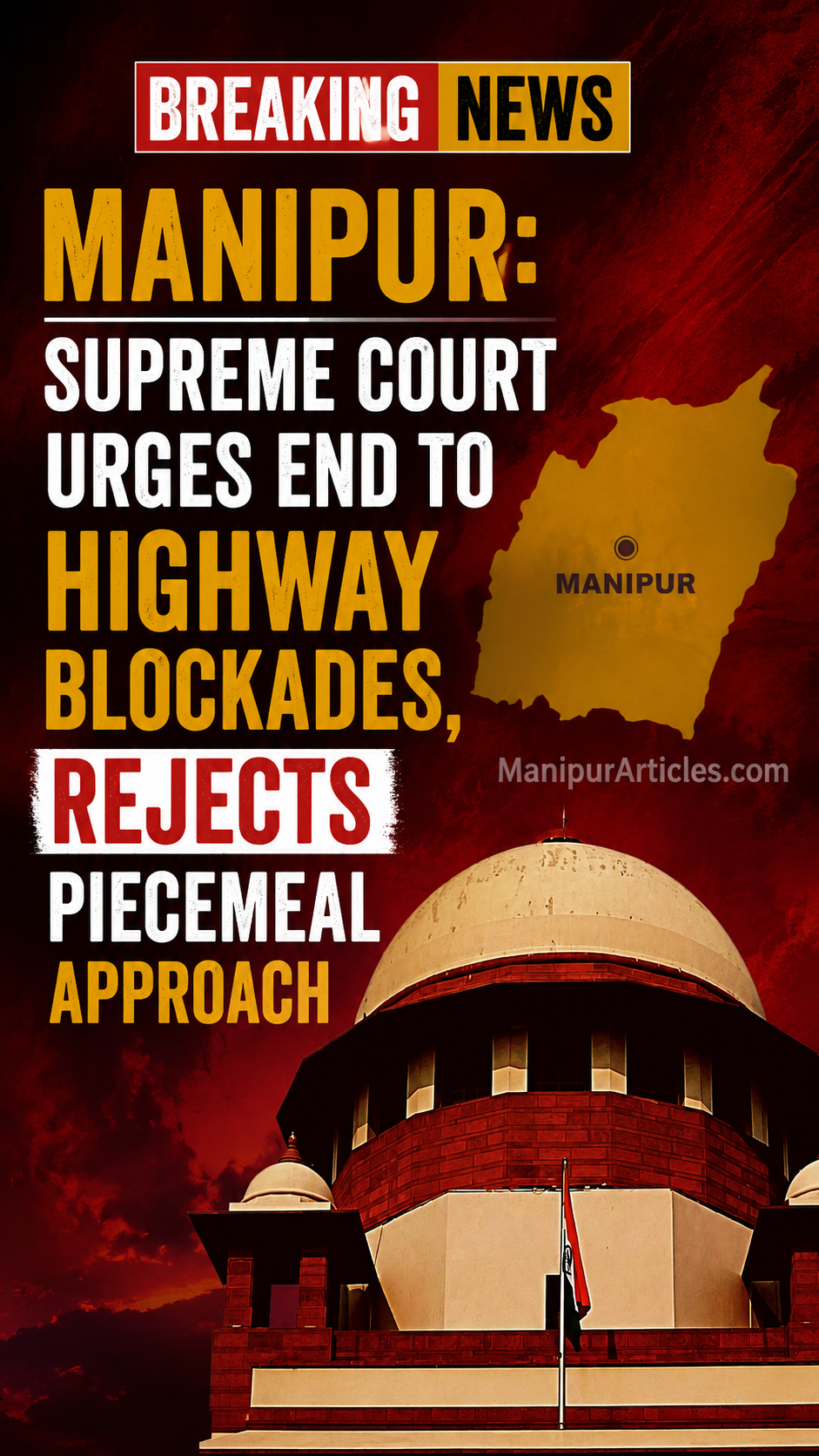
Manipur: Supreme Court Urges End to Highway Blockades, Rejects Piecemeal Approach
New Delhi/Imphal: The Supreme Court has called for an end to blockades on national highways in Manipur, stressing that the state’s highways serve as an economic lifeline for all communities and that disruptions affect the entire population.
A bench comprising Chief Justice of India Surya Kant and Justices Joymalya Bagchi and J.V. Mohana urged the parties involved to adopt a comprehensive approach rather than seeking solutions for individual roads or isolated blockades.
Court Seeks Complete List of Blocked Highways
The directions came during the hearing of a Public Interest Litigation (PIL) concerning a highway blockade in Kangpokpi district.
The Supreme Court directed the petitioner and opposing parties to provide comprehensive information on all national highways currently affected by blockades across Manipur.
The court also sought practical proposals for restoring traffic on the blocked routes and ensuring the uninterrupted movement of essential supplies.
Supreme Court Rejects Selective Approach
The Bench made it clear that it would not address the highway crisis on a piecemeal basis.
The court observed that reopening one particular route while other highways remain blocked would not provide a lasting solution to the broader disruption affecting the state.
Instead, the parties have been asked to identify all affected routes and develop a coordinated plan for restoring normal traffic movement.
Highways Called Economic Lifelines
The Supreme Court emphasised the importance of national highways for people across communities in Manipur.
The court noted that prolonged blockades disrupt the movement of food, essential commodities and other supplies, affecting ordinary residents regardless of their community background.
The Bench therefore urged all communities to work towards clearing the blockades and restoring the free movement of traffic.
Concerns Over Food and Education Raised
During the hearing, Senior Advocate Anand Grover, appearing for the Kuki Women Organisation for Human Rights, highlighted the difficulties faced by people in Kangpokpi district.
He reportedly pointed to shortages of food and disruptions to schooling caused by the highway blockades.
The submissions underlined the wider humanitarian consequences of prolonged disruption to transport routes.
Rival Groups Present Different Claims
Meanwhile, Ngangom Junior, appearing for the International Meitei Organization, argued that groups represented by the petitioners were also maintaining blockades on alternative state routes.
He described the petition as mischievous and disputed the presentation of the issue by the petitioning side.
The competing submissions reflected the broader disagreement between groups over responsibility for blockades and disruptions affecting movement in Manipur.
Court Cautions Against Immediate Broad Orders
The Chief Justice also cautioned that sweeping judicial directions requiring immediate intervention by the state could potentially create risks for civilians if implemented without adequate consideration of local conditions.
The Bench indicated that any solution must take into account the sensitive security environment and avoid measures that could trigger localised violence.
The court therefore favoured a coordinated and mediated process involving all sides.
Neutral Agency Proposed for Traffic Restoration
The Supreme Court directed the parties to submit a complete list of blocked routes along with workable proposals aimed at achieving a mediated consensus.
The proposed framework would allow traffic to move freely under the supervision of a neutral agency.
The court’s approach seeks to address the wider highway disruption across Manipur rather than focusing on a single blockade or route.
Focus on Restoring Essential Movement
The latest proceedings place the restoration of highway connectivity at the centre of efforts to reduce the impact of blockades on civilians.
With national highways playing a crucial role in transporting food, fuel, medicines and other essential goods, the court’s directions could pave the way for a broader mechanism to restore traffic across affected routes.
The matter will continue to be monitored as the parties prepare comprehensive information and proposals for consideration by the Supreme Court.
Disclaimer: The statements attributed to the parties reflect their respective submissions during court proceedings and should not be treated as judicial findings regarding responsibility for any particular blockade.