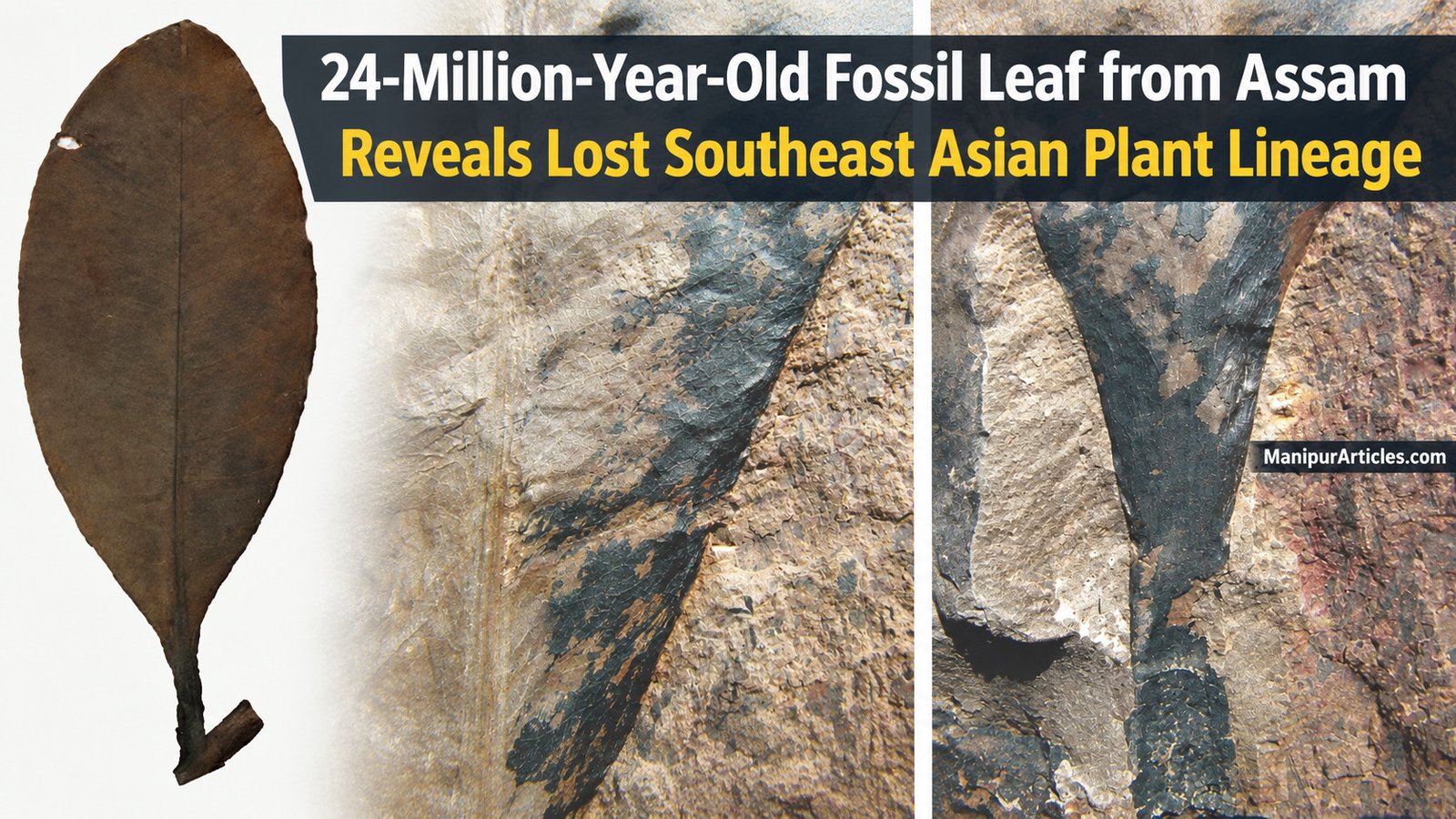
24-Million-Year-Old Fossil Leaf from Assam Reveals Lost Southeast Asian Plant Lineage
A fossil leaf discovered in Assam’s Makum Coalfield has provided new evidence about the ancient distribution of a plant lineage that today survives only in the peat-swamp forests of Southeast Asia.
The nearly 24-million-year-old fossil was found in the late Oligocene deposits of the Tikak Parbat Formation in Tinsukia district. Scientists have identified it as a new fossil species, Tetrameristophyllum makumensis, which closely resembles the modern Tetramerista glabra found in freshwater peat-swamp forests of western Malesia.
The discovery, reported in the Geological Journal, indicates that the Tetrameristaceae plant family once existed much farther west than its present-day range. Researchers suggest the lineage disappeared from the Indian subcontinent after the late Oligocene, around 24–23 million years ago.
The study, led by Harshita Bhatia with Gaurav Srivastava of the Birbal Sahni Institute of Palaeosciences, suggests that ancient Assam provided suitable wetland conditions for the plant.
Habitat Loss May Have Driven Its Disappearance
Researchers found that climate alone may not explain why the plant disappeared from India. An analysis of climatic conditions across modern populations showed considerable similarities among members of the plant family.
Instead, scientists believe changes in wetlands and freshwater peat-swamp habitats may have played a major role. Tectonic and landscape changes linked to the India-Asia convergence, Himalayan development and changes in the Asian monsoon could have altered the permanently waterlogged environments required by the plant.
The fossil suggests that as these specialised habitats disappeared or changed, the plant lineage was gradually lost from the Indian region while surviving in Southeast Asia.
The discovery also highlights the importance of protecting peat-swamp ecosystems, many of which are under pressure from logging, drainage and plantation development.
The Assam fossil provides a long-term example of how the loss of specialised habitats can reshape the distribution of plant species over millions of years.
Source:- Northeast Now